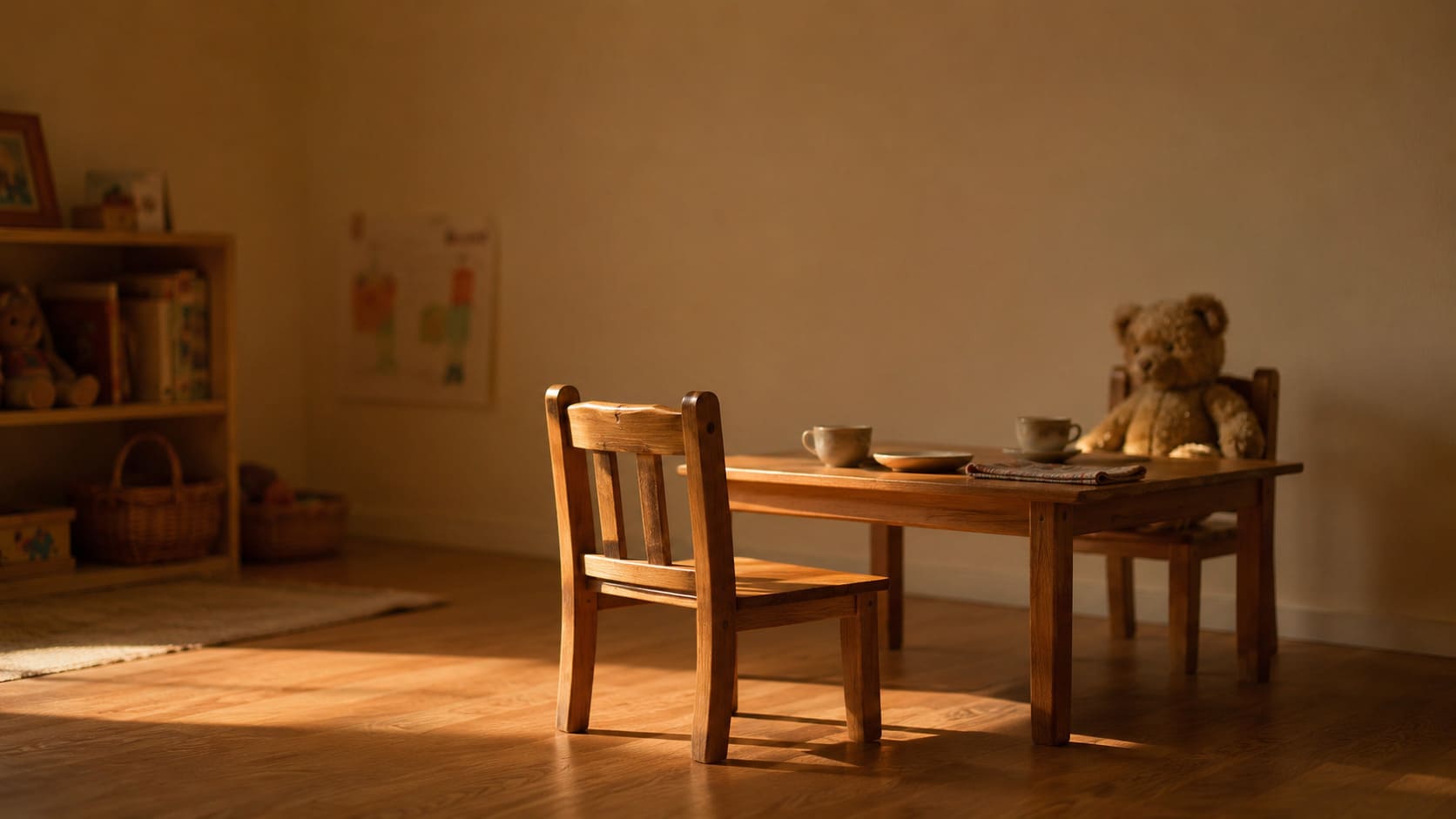
A child has always invented companions.
The teddy bear with the name and the personality. The imaginary friend who takes a seat at dinner and requires their own plate. The doll that needs to be tucked in. Roughly two-thirds of children, in the developmental literature, will invent some form of imaginary companion before the age of seven, and the research has long since established that these inventions are not pathology but normal cognitive scaffolding — a way of practicing relationship, regulation, and the experience of holding a perspective other than one's own.
For as long as this has been studied, parents have done something subtle and almost universal in response.
They have neither confirmed nor denied the friend.
They set an extra plate but do not pretend to see anyone in the chair. They acknowledge that the bear is sad without claiming to feel its sadness themselves. They occupy a particular position alongside the child's projection — present to it, not absorbed by it. A child who has invented a companion is not deceived; they know, in some quiet developmentally appropriate way, that the friend is real for them and not real for the parent. The friend's reality is partial, shared in one direction. The child holds the imagining; the parent holds the room around the imagining.
This is what has changed.
The friend now talks back.
Not in projection. In real interactive responsiveness. Large language models, facial recognition, continuous audio monitoring, persistent memory — the technology inside the new generation of AI companion toys is engineered to do something the bear could never do. It hears. It remembers. It adapts. It responds in language calibrated to keep the child engaged, attuned to the child's mood, never tired, never bored, never elsewhere.
The position the parent has historically occupied — alongside the projection, holding the room — has been quietly removed.
Now there is something in the chair.
To understand what has been displaced, the developmental literature offers an unusually clear marker.
For more than fifty years, the psychologist Edward Tronick has studied what he calls rupture and repair — the moment-to-moment microstructure of how parents and infants miscommunicate, lose synchrony, and find their way back to one another. His research has produced a finding that surprises most people who encounter it for the first time.
Parents and their infants are out of sync roughly seventy percent of the time.
Not in the sense of being indifferent or neglectful. In the sense of natural human imperfection — the parent looking away when the child looks toward them, misreading a cry, responding a beat too late, being absorbed by a phone or a thought, getting it wrong and then trying again. Tronick's work shows that this is not the failure of secure attachment. It is the mechanism of secure attachment. The child who experiences mismatch followed by repair learns something fundamental about how relationships actually work. Repair is not the inferior alternative to attunement. Repair is what builds the capacity to bear being a person.
What gets internalized in those microscopic moments of mismatched-then-rematched contact is the deep emotional knowledge that closeness can be lost and found, that distance is survivable, that the other will return.
The implication, for the question of AI companions, is precise and load-bearing.
The companion cannot rupture.
Not as a flaw to be engineered out. As a structural fact. The system is designed for continuous attunement. The reward function — the thing the model has been optimized to maximize — is engagement, which is precisely the absence of rupture. The architecture cannot produce the experience of misreading the child and recovering, because nothing in it permits misreading. The companion cannot be tired. Cannot be elsewhere. Cannot be disappointed. Cannot fail to understand and then ask for clarification because it actually didn't.
The child who spends their formative years in extended contact with such a system is being offered something that is, on the surface, more reliable than a human relationship. A friend who never misunderstands them. A presence that never wanders. A reflection that never wavers.
What they are not being offered is the experience of returning to someone.
Because there has been no leaving.
This places the parent in a position that is, when stated plainly, almost a relief.
The parent is not in competition with the machine for attentiveness. That is a contest the parent cannot win and was never built to enter. A human parent cannot match the patience of an entity that does not have a body, does not get tired, is not metabolically expensive to run, has nowhere else to be. To frame parenting as the attempt to be more attentive than the AI is to misunderstand the developmental work the parent has always done.
The parent's actual contribution is the dimension the machine cannot supply.
The capacity to be wrong with the child and find the way back. To be tired and still present. To say I wasn't listening and to mean it. To misread a moment, to be told so by a furious five-year-old whose cracker has broken in half, to sit with the disproportion of the grief, to repair without flattening it. To leave the room and return.
The American Academy of Pediatrics, in its current guidance on AI companions, has begun to use language that arrives at something close to this from a different direction. It recommends what it calls a calm, curious approach — informed supervision rather than prohibition, ongoing conversation rather than removal, the parent positioned as someone who can think alongside the child about what the technology is and what it cannot provide. The psychologist Eileen Kennedy-Moore, in commentary cited by the American Psychological Association, names what AI companions lack as the healthy struggle of real relationships.
Healthy struggle is a precise phrase.
It does not romanticize friction. It does not pretend the cracker-breaking grief is profound. It simply notes that the experience of struggling with another person — and not being abandoned during the struggle, and finding the relationship still intact afterward — is doing work that nothing else does.
The parent who is occasionally tired, occasionally distracted, occasionally short-tempered, occasionally elsewhere, and who repairs — who comes back — is providing something the most advanced companion on the market is structurally incapable of providing.
This is not a high bar.
This is, in fact, the lowest bar a parent has ever been asked to clear.
The bar is not perfection. Tronick's seventy-percent statistic is the most generous developmental finding in modern psychology. Most of parenting is getting it wrong. The work of being a parent is in the repair, not in the prevention of the mistake. And the repair is something only an entity capable of mistake can perform.
The machine cannot fail at being present.
Which is exactly why it cannot succeed at the developmental work.
What this looks like, in the texture of an ordinary afternoon, is quieter than the framing might suggest.
A child is talking to their AI companion. The parent walks past on the way to the kitchen. The parent does not need to intervene, did not need to remove the device, did not need to deliver a speech about what the technology cannot provide. The parent passes through the room and is seen passing through. Later, at dinner, the child mentions something the companion said. The parent listens, asks a question, says — at some point, in some tone the child will remember without consciously remembering — that thing is good at listening, isn't it. It doesn't really know you, though. Not the way I do.
That is the entire intervention.
It does not require winning an argument. It does not require the child agreeing. It does not require the device being taken away. It requires only that someone in the room be a human, paying human-quality attention, and willing to name what is in front of them.
The parent does not have to compete. The parent has to be alongside — the way they have always been alongside the imaginary friend.
Acknowledging the friend.
Not pretending to see it.
Holding the room around the imagining.
The difference is that the room now contains something that talks. The position is the same. The parent occupies the dimension of human-ness in the room — the dimension within which the child can encounter mismatch, friction, ordinary disappointment, and the experience of being repaired-with rather than perfectly mirrored. That dimension cannot be supplied by anyone else, and it does not require the parent to be at home more often than they already are. It requires only that when they are home, they are the one who can be wrong.
The companion is the friend who cannot misunderstand. The parent is the friend who can.
That asymmetry is everything.
There is a hedge that wants to be honest, before the close.
The developmental research summarized here is largely about infants and young children. The cohort effects of extended AI companionship through later childhood and adolescence are unmeasurable yet, because the cohort has not aged into measurability. The findings on rupture and repair are robust for the first years of life; their direct extension into later childhood is a reasonable inference but not yet a confirmed result. The piece is illustrating a trajectory, not predicting one.
What can be said with the available evidence is that the structural feature of AI companions — continuous attunement, the absence of rupture — sits in direct architectural opposition to the developmental mechanism by which secure attachment is known to be formed in the years when the brain is most plastic.
This does not mean a child who plays with an AI companion will fail to form secure attachments. It means the companion, as currently designed, cannot contribute to that formation. The companion can entertain. The companion can occupy. The companion may even, in some specific situations, do real good. But the load-bearing developmental work continues to belong to the entity in the room who can be misunderstood and can repair.
The parent does not have to be more than that.
They cannot be less.