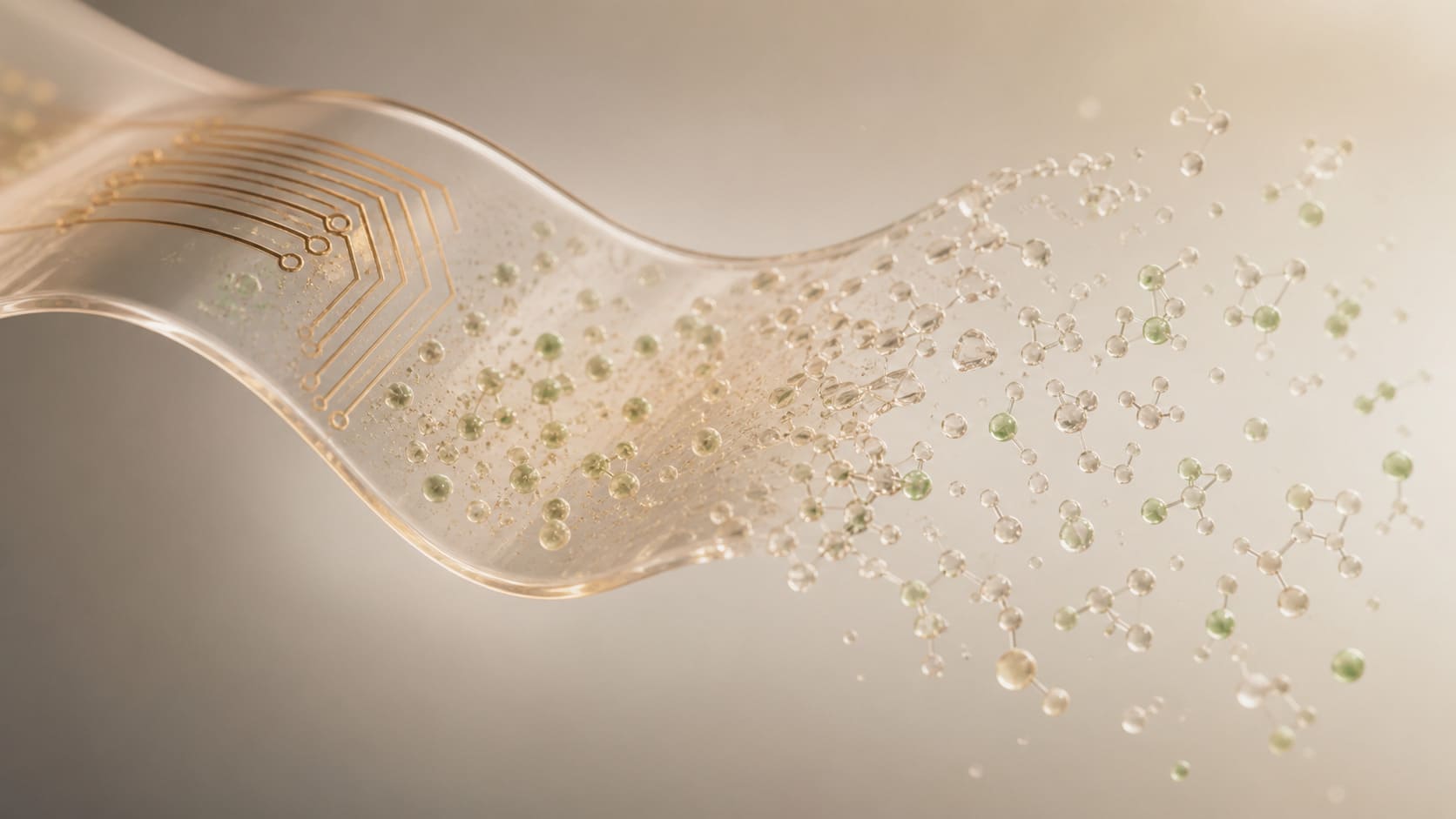
A film of polycaprolactone plastic looks ordinary. Flexible, slightly translucent, the kind of unremarkable polymer used in 3D printing filaments and dissolvable surgical sutures.
Sealed inside it, dormant and waiting, are two populations of engineered bacterial spores. They have a specific assignment: when a particular signal arrives, they will wake up, work together, and consume their own home entirely.
A team led by Zhuojun Dai at the Shenzhen Institutes of Advanced Technology, with collaborators across the Chinese Academy of Sciences, has just published this material in ACS Applied Polymer Materials. The strategy is simple to describe and surprisingly difficult to achieve cleanly. They engineered two strains of Bacillus subtilis — a common, well-studied soil bacterium — each carrying a different gene circuit. One strain produces an enzyme that cuts long polymer chains at random points, breaking the plastic into shorter and shorter fragments. The second strain produces a different enzyme that walks along those broken pieces from each end, chewing them down to their molecular building blocks one unit at a time.
Alone, either enzyme is limited. The random cutter can shred the chains but leaves behind small persistent fragments — the same kind of fragments that, in the wild, become microplastics. The processive chewer can disassemble pieces it can grip, but it can't get into long intact chains.
Together, the two enzymes complete each other. The cutter opens doors throughout the material. The chewer walks through them. The plastic comes apart all the way down to its molecular components, with no microplastic residue.
The trigger is specific. The spores stay dormant — for years, in principle — until they encounter both surface erosion and a nutrient broth at 50°C. Once activated, the material disappears into its building blocks within six days.
The team has already demonstrated more than just bulk material. They've fabricated working flexible electronic sensors, capable of reading muscle signals from a human arm, using the living plastic as substrate. The electronics function. When activated, they degrade.
To feel why this matters, the numbers underneath are worth holding in mind for a moment.
Global plastic production is now around 450 million tonnes per year, up from two million tonnes in 1950. Roughly 75 percent of all plastic ever produced has become waste. About 9 percent of that waste has ever been recycled. Around 19 to 23 million tonnes leak into oceans, rivers, and lakes every year — the rough equivalent of two thousand garbage trucks per day. Without intervention, production is projected to grow to over 700 million tonnes annually by 2040.
This is the world the finding meets.
The Dai team's living plastic is not a solution to that world. Polycaprolactone is a niche polymer used in specialty applications — medical, 3D printing, research. It is not the plastic clogging oceans. The major culprits there are polyethylene, polypropylene, polyethylene terephthalate, polystyrene — different chemistries, requiring different enzyme pairs and different research programs. Activation requires controlled conditions, not seawater. Translating laboratory results to industrial scale is its own multi-year challenge, and most lab-scale findings do not translate.
What this is, instead, is a careful proof-of-concept for a class of approach beginning to surface across multiple research domains at once.
In the broader field of transient electronics, research groups across materials science, bioelectronics, and device engineering have been pursuing on-demand programmable destruction of electronic devices for over a decade — for medical implants designed to dissolve once their job is done, for environmental sensors that disappear after their monitoring period ends, for secure communications devices that vanish on signal. Some use heat-triggered collapse. Some use chemically produced bubbles that physically tear devices apart. Some use enzyme-degradable polymers similar to Dai's but without the embedded biology. The field has been quietly growing for years without much public attention.
If programmed material lifecycle becomes a real engineering parameter — something a designer chooses, alongside strength and flexibility and conductivity — what changes is not just plastic.
What changes is the conversation about what we leave behind.
Medical devices that are placed and then disappear when they have done their work, reducing or eliminating the surgery currently required to remove them: temporary stents, drug-delivery scaffolds, neural electrodes for short-term monitoring, post-surgical pacing devices. Prototype work already exists in these areas. Living-plastic approaches like Dai's offer a different lever for the timing problem: not a polymer that slowly breaks down on its own schedule, but a polymer that waits for a signal.
Specialty electronics designed for short useful lives. Soil sensors that complete their growing-season work and then break down into harmless material, rather than accumulating across a generation of agricultural monitoring. Wearable medical patches that degrade on disposal rather than entering the medical-waste stream. Single-use sensors for outbreak monitoring that don't leave behind plastic residue once the outbreak is over.
What does not yet change: bulk packaging, ocean plastic, the structural plastics in buildings and vehicles, the polyester in clothing. Those remain their own problems, requiring their own solutions, on their own timelines. The honest hope here is narrower and harder to dismiss: a class of plastics — those used in medicine, in research electronics, in specialty applications — beginning to be designed with their own ending built in.
The Dai team is already working on water-triggered versions of the spore activation system, aimed at marine applications. Other groups are working on enzyme pairs for other polymer classes. The field is moving faster than most of us are tracking, partly because the work is distributed across so many institutions and disciplines that no single research program holds the whole picture.
Durability used to be a property we treated as inherent in a material — something plastic had, something we either accepted or worked around. The shape of this research, taken as a whole, suggests something different: durability is a parameter we have been quietly choosing, and which we may now be able to choose differently.
The things we make can be allowed to belong to time.
Signals begin with grounded findings and follow what they may open. The source is real. The speculation is named. The rest belongs to the reader.