A battery electrode usually begins wet.
Powders are mixed into a slurry. Active materials, conductive additives, binders, and solvent become a spreadable paste. That paste is coated onto thin metal foil. Then the solvent has to be dried away, recovered, managed, and controlled.
The finished electrode may be thin.
The factory around it is not.
Long drying lines. Energy-intensive ovens. Solvent handling. Large production footprints. Capital equipment. Environmental controls. Process steps that do not store a single electron, but make the electron-storage material possible.
This is one of the quiet burdens inside the energy transition.
We talk about better batteries as if the battery itself is the whole story: more range, faster charging, longer life, safer chemistry, cheaper storage.
But before any battery can stabilize a grid, power a car, hold rooftop solar, or keep a neighborhood alive during an outage, someone has to manufacture it.
And manufacturing has its own architecture.
A growing body of work in dry battery electrodes is trying to change that architecture.
Instead of beginning with slurry and solvent, dry-electrode processes work with solid materials directly. Powders are mixed, structured, pressed, coated, or compacted without the wet stage that conventional electrode manufacturing depends on. The goal is not cosmetic. It is to remove some of the most space-hungry, energy-hungry, solvent-heavy steps in battery production.
A 2026 study in Nature Energy from the University of Chicago Pritzker School of Molecular Engineering pushed this beyond the usual manufacturing promise. Researchers designed a dry-processed electrode architecture that couples fibrous carbon and binder at the molecular level, creating a conductive network inside thick, high-loading electrodes. The result: electrodes with more than 99 percent active material, stable operation at high voltage, and lithium-ion pouch cells that retained 78 percent of their capacity after 1,000 cycles.
The finding is technical.
The opening is not.
If battery electrodes can be made with fewer solvents, fewer drying steps, smaller factory footprints, and strong performance, then the question begins to widen.
Not simply:
Can we make better batteries?
But:
Can we make batteries in a way that changes where energy power can live?
To feel why this matters, start with the grid.
The modern electric grid is one of humanity's great collective machines. It moves power across distance, balances supply and demand moment by moment, and lets cities, hospitals, factories, homes, farms, schools, and data centers draw from a shared system most people rarely notice until it fails.
But the grid also has a shape.
Power is generated somewhere. Transmitted somewhere else. Distributed outward. Most homes and neighborhoods sit at the edge of that system, receiving energy rather than holding much of it.
That architecture worked well for a world built around large centralized generation.
It is under strain in a world of wildfires, storms, heat waves, cyber risk, aging infrastructure, rising electricity demand, and intermittent renewable generation.
Solar and wind change the timing of power. Electrified vehicles and heat pumps change the demand profile. Extreme weather changes the meaning of outage. A blackout is no longer only inconvenience. For many people, it can mean heat without cooling, medical devices without backup, communication without charge, food without refrigeration, elevators without power, neighborhoods without resilience.
Batteries enter this story as more than storage boxes.
They are timing devices.
They let electricity generated at one moment become useful at another. They let solar power continue after sunset. They let buildings ride through short outages. They let microgrids disconnect from the main grid and operate locally when the larger system is down. They let energy become less instantly perishable.
The International Energy Agency has said battery storage must scale rapidly for the world to meet clean energy and energy-security goals. In its net zero scenario, global energy storage capacity rises to 1,500 gigawatts by 2030, with batteries providing most of that growth.
That is the scale of the need.
But scale is not only about chemistry. It is about factories.
If batteries remain expensive to manufacture, difficult to scale, solvent-heavy, energy-intensive, geographically concentrated, and capital-hungry, then storage remains bottlenecked before it ever reaches the neighborhood.
Dry electrodes do not solve that by themselves.
But they press on one of the bottlenecks.
They ask whether the battery factory can become smaller, cleaner, less solvent-dependent, less energy-hungry, and easier to scale.
And underneath those questions, another shift becomes visible.
A factory that requires less capital, less land, fewer environmental controls, and less specialized chemistry is also a factory that fewer countries and fewer companies need to dominate. Today, battery manufacturing is concentrated — a handful of nations, a handful of firms, facilities at a scale only certain capital structures could reach. Some of the reasons for that concentration are the very factory characteristics this research is trying to change.
Make the factory more modest, and the question of who manufactures begins to shift. Regional production becomes more plausible. New entrants can build at scales the dominant players previously made unreachable. Supply chains shorten. The bottleneck does not disappear. It moves.
Storage stops being something only certain places can produce, and starts becoming something more places can build, hold, and own.
That is where the edge begins to matter.
The word "edge" has two meanings here.
It means the edge of the grid: the home, building, farm, school, clinic, apartment block, campus, village, or neighborhood where electricity is actually used.
It also means the edge of an industrial system: the place where energy storage might stop being only a centralized utility asset and start becoming a distributed capacity.
The early internet carried a powerful architectural idea: a network of nodes, not one fragile center. If part of the network failed, other parts could still communicate. Intelligence and resilience were distributed across the system.
The analogy is imperfect.
Electricity is not information. Power must obey physical constraints that packets of data do not. A neighborhood battery cannot route electrons around the world like an email. The grid cannot simply become "the internet," and pretending otherwise would flatten the engineering.
But the architectural rhyme is still worth holding.
A system becomes different when its edges can do more.
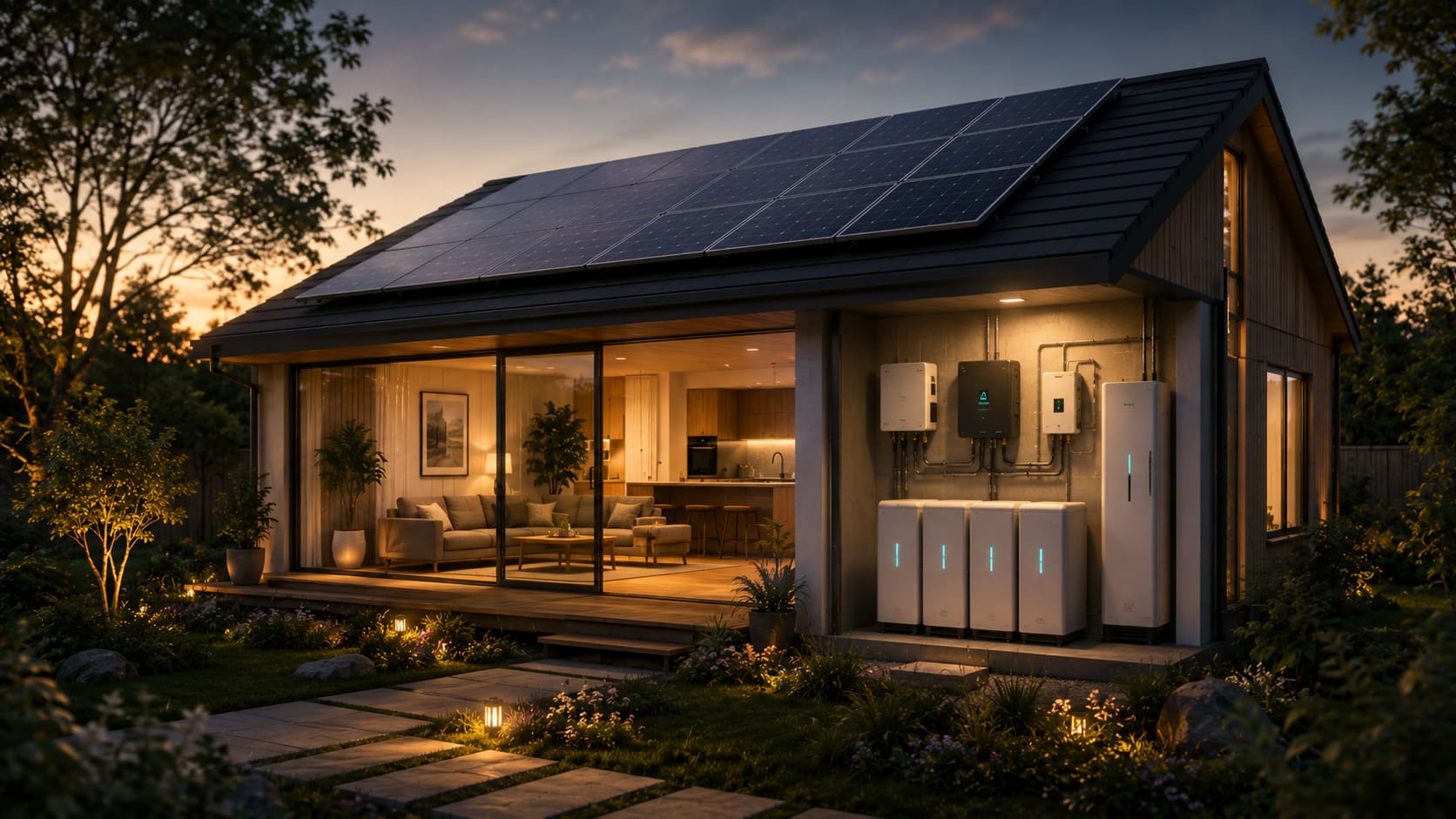
A home with solar panels but no storage still depends heavily on timing. A home with storage can hold some of its own daylight.
A neighborhood with rooftop solar but no coordinated storage still sends and receives energy mostly through the old pattern. A neighborhood with shared batteries, smart inverters, microgrid controls, and fair governance begins to become something else.
Not off-grid fantasy.
Not rugged individualism with lithium cells.
Something more useful:
A connected edge with memory.
Power generated locally can be stored locally. Essential loads can be prioritized during outages. Community buildings can become resilience hubs. Apartment blocks can share storage instead of leaving backup power only to those who can afford a private system. Rural and remote communities can reduce diesel dependence. Clinics and schools can ride through failures that would otherwise cut them off.
The grid does not disappear.
Its meaning changes.
Instead of being the only lifeline, it can become an exchange layer: a system that connects, balances, trades, supports, and backs up local nodes that are more capable than before.
That future does not arrive because one electrode architecture improves.
It would require policy, financing, safe chemistries, recycling, local generation, utility reform, building codes, power electronics, software, maintenance, and social trust.
But battery manufacturing is one of the hidden foundations beneath all of it.
If storage is too expensive, too dirty to make, too supply-constrained, or too centralized, energy sovereignty remains a luxury product.
If storage becomes cheaper, cleaner, safer, and easier to deploy, then the edge starts to strengthen.
This is where dry electrodes become more than a factory improvement.
Conventional wet electrode production has a long process chain: mixing, coating, drying, recovery, densification, optimization. Dry approaches try to remove the wetness from the beginning. Some use calendering, pressing powder into films. Some use dry mixing, fibrillated binders, extrusion, or electrostatic methods. Different institutions are approaching the problem from different angles, but the shared pressure is visible.
Make the electrode with less burden.
Make the factory smaller.
Use less energy before the battery ever stores energy.
Reduce solvent handling.
Increase active material.
Improve the architecture inside the electrode, not only the chemistry inside the cell.
That last point matters.
The 2026 Nature Energy work did not simply say dry processing is cleaner. It showed that architecture itself can unlock performance: a better internal network of carbon and binder allowed high active-material content and stable high-voltage operation without redesigning the active material or relying on specialized electrolyte additives.
In plain language:
Sometimes the battery does not only need a better ingredient.
It needs a better way for its ingredients to touch.
That is a larger lesson.
The energy transition is often described as a change in sources: coal to solar, oil to electricity, gas to storage, combustion to electrons.
But it is also a change in arrangements.
Where power is made.
Where power is held.
Who can afford backup.
Who owns the storage.
Which communities stay powered when the line fails.
Which factories can scale without reproducing the same environmental burdens they are meant to help reduce.
Which parts of the system remain centralized, and which parts learn to hold themselves.
Dry electrodes are not the answer to all of that.
They are a signal from one layer of the stack.
A quieter, cleaner, more compact battery factory may seem far away from a neighborhood riding through a blackout. But the line between them is real. It runs through cost, scale, availability, performance, manufacturing geography, and the practical question of whether storage can become ordinary enough to be civic infrastructure.
Not glamorous.
Ordinary.
That may be the real threshold.
Energy independence will not look like every house cutting itself loose from the world.
It may look like homes, buildings, neighborhoods, campuses, and towns becoming less helpless at the edge.
Still connected.
Less dependent.
Able to hold some of their own weather.
The honest caution is simple.
Dry electrode manufacturing is still a developing field. Different methods have different challenges. Scaling laboratory processes into stable industrial production is difficult. Battery safety, mineral supply, recycling, cost, degradation, and regulation still matter. A cleaner electrode process does not automatically produce just energy systems, resilient communities, or affordable storage.
Technology does not distribute its own benefits.
People, institutions, markets, policies, and communities decide that.
But some technologies change what can realistically be decided.
A battery made with less solvent, less drying, less factory burden, and more active material does not guarantee energy freedom.
It does something smaller and more important.
It lowers one wall between the present grid and a more distributed one.
The grid may remain one of civilization's great shared machines.
But the edge does not have to remain passive.
A neighborhood that can store power is no longer only the end of a wire.
It is a node learning to remember light.